Yolatech at the 27th Epoxy Resin Conference in Xiantao
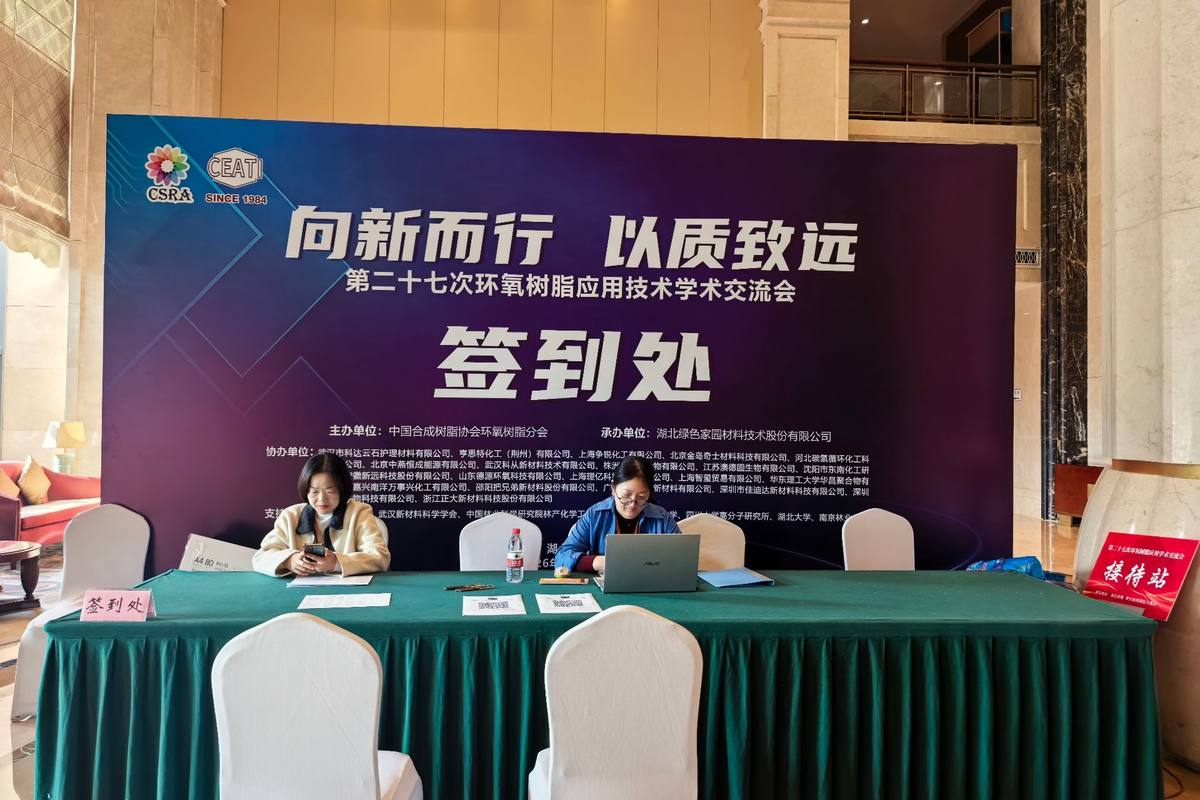
Yolatech attended the 27th Epoxy Resin Conference in Xiantao, Hubei Province, China, held from 21 to 24 October 2026. The full name is the 27th Epoxy Resin Application Technology Academic Exchange Conference, run by the epoxy branch of the China Synthetic Resin Association, a body founded in 1984.
What the 27th Epoxy Resin Conference Covered
This is a working meeting rather than a trade fair: reports run back to back in one hall, so a delegate hears every paper instead of choosing a track. Proceedings are printed, and a display area outside the hall carries raw materials and test equipment.
The 2026 theme was Move with Innovation, Last on Quality. Papers covered specialty epoxy resins, curing agents and additives, then the sectors that consume them: adhesives, electrical insulation, coatings, wind and new energy, aerospace and rail, and communications hardware.
Table 1. The 27th Epoxy Resin Conference at a glance
Item
Detail
Meeting
27th Epoxy Resin Application Technology Academic Exchange Conference
Theme
Move with Innovation, Last on Quality
Dates
21 to 24 October 2026, registration on 21 October
Location
Xiantao, Hubei Province, China
Host
Epoxy Resin Branch, China Synthetic Resin Association
Organiser
Hubei Greenhome Materials Technology, Inc.
Programme
23 scheduled report slots on 22 and 23 October, branch committee meeting on 21 October, plant visit on 23 October
Format
Plenary reports, technical reports, printed proceedings, product and technology display area
Figure 1. The single plenary hall in Xiantao, where the report slots ran without parallel sessions.
Bridge Deck Numbers Behind Epoxy Asphalt Demand
The paper that drew the most note-taking was a thirty-year review of epoxy resin modified asphalt for bridge deck surfacing, by Hang Longcheng. It put the installed base on the screen instead of arguing the case for the technology.
Four figures carry it. China has 87,900 km of medium and large bridges in service, roughly 880 to 1,050 million square metres of deck. Epoxy modified binder use sits at 65,000 tonnes a year, deck and steel deck combined, growing 15 to 20 percent a year.
Table 2. Deck paving figures presented at the conference, 22 October 2026
Metric
Figure
Basis given in the report
Bridges in service
8,790.71 万米, about 87,900 km
Medium and large bridges, total deck area about 880 to 1,050 million sq m
Epoxy modified binder
65,000 t/yr
Deck and steel deck combined, growing 15 to 20 % a year
Epoxy asphalt laid
5.0 million sq m/yr
Against 140 million sq m of routine deck resurfacing a year
New steel deck
4.5 million sq m/yr
30,000 to 33,000 new bridges a year, 4 % of them steel deck
The mechanism explains why the binder figure matters more than the area. Epoxy asphalt is a thermoset, so the cured surfacing holds stiffness at summer deck temperatures where conventional asphalt ruts, and it bonds to an orthotropic steel deck that flexes under every axle. Pot life and viscosity bound the laying window.
Figure 2. Deck paving data on screen during the bridge deck review, 22 October 2026.
Three Threads That Touch Our Product Lines
Reactive diluents carried a full slot, with Zhu Xinbao of Nanjing Forestry University reviewing progress and direction in the chemistry. The question underneath is the one buyers put to us: how much diluent a system tolerates before toughness and glass transition pay for the viscosity drop. Our reactive diluent range is built around that trade-off, from monofunctional glycidyl ethers to the C12-C14 alkyl grade YLD-7003 at 294 to 313 g/eq.
Amine hardeners came at the same problem three ways: a benzyl-modified amine synthesis from the host company's technical manager, a specialty amine paper from Wanhua Chemical, and a polyamide built on tung oil methyl ester dimer. Cure speed and wet adhesion at low temperature were the recurring targets, the ground our modified amine curing agents are formulated on.
Anhydride systems produced the most quantitative paper. Zhang Jianlin examined how the trans isomer content of methyl tetrahydrophthalic anhydride shifts thermal, mechanical and electrical insulation results under different accelerators, a specification question for an electrical part rather than a preference. That is why assay and isomer data are published for MHHPA, CAS 25550-51-0.
Two papers pointed forward. Adhesives for humanoid robots and low-altitude aircraft ask for the same resin family at a different balance of toughness, thermal cycling and weight. Degradable epoxy resin, designed to come apart at end of life, is still a laboratory result, but it shared a programme with bridge deck paving.
Table 3. Conference threads mapped to our product lines
Conference thread
What it decides in a formulation
Where it maps in our range
Reactive diluent design
Viscosity against toughness and glass transition
Monofunctional, difunctional and polyfunctional diluents
Benzyl and specialty amines
Cure speed and adhesion at low temperature
Modified amine hardeners quoted by AHEW
MTHPA isomer content
Thermal, mechanical and insulation results of anhydride cures
MHHPA with assay and isomer data
Epoxy asphalt deck paving
Pot life, deck adhesion and fatigue under traffic
Liquid bisphenol A epoxy resin with amine hardener
Civil engineering adhesives
Declared strength and durability data
Polyetheramine D-230 for room-temperature cure
What an Overseas Buyer Can Take From It
The epoxy resin conference in Hubei looks local, and the deck figures describe a domestic market. It travels because the cost curve for epoxy asphalt, and for the diluents and hardeners behind it, gets set where the volume is.
The second reason is standards. A session covered the Chinese civil engineering adhesive standards in force from 2026 and those still in development, including what a supplier must declare on strength and durability. Buyers outside China meet those clauses in tender documents, because the contractors who build the decks export the method.
Details of the grades in Table 3, with TDS and AHEW or EEW against each, are available on request, and our page on epoxy resin in civil engineering and construction sets out how resin, hardener and diluent are matched for deck, grouting and structural adhesive work. Send a target viscosity, EEW or AHEW and we will quote the nearest production grade.
عرض المزيد









 راسلنا عبر البريد الإلكتروني
:
راسلنا عبر البريد الإلكتروني
: 






 شبكة IPv6 المدعومة