

اللغة
:

اللغة
:

ASE CHINA 2026 is the 29th China International Adhesives and Sealants Exhibition, held in Shanghai from 15 to 17 September 2026. Nanjing Yolatech Co., Ltd. exhibited at booth E2676 in Hall E2 of the Shanghai New International Expo Centre, presenting epoxy resins, curing agents and reactive diluents.
The show filled halls E1 to E4 at the Shanghai New International Expo Centre in Pudong, running alongside the 21st China International Adhesive Tapes and Films Exhibition. The organiser reported 710 exhibitors, more than 200 of them first-time, on a floor area above 40,000 square metres.
Product scope at ASE CHINA 2026 ran wider than at a typical adhesives show. Beside finished adhesives and sealants, the halls carried tapes, functional films, dispensing and dosing equipment, radiation-curing materials and bio-based raw materials, so a formulator could compare a base resin and the equipment that dispenses it in one walk.
The organiser framed the edition around AI computing, high-speed optical communication, photovoltaic and energy storage, semiconductors, humanoid robots and automotive electronics. Four technical sessions ran in the E4270 conference area, covering tapes and functional films, electronic chemicals, adhesives for emerging industries, and raw material innovation.
Yolatech's booth covered lines that usually come from separate suppliers: base epoxy resins, specialty and modified resins, curing agents, and reactive diluents. Keeping them on one stand matters for adhesive formulators, because a change of diluent or hardener shifts the whole mix rather than one component. See the epoxy systems used in adhesives for the application side.
| Product line | On the booth at E2676 | Where it is used |
| Base epoxy resin | Liquid and solid bisphenol A, bisphenol F, waterborne | Laminates, flooring, adhesives |
| Specialty and modified resin | Novolac, cycloaliphatic, hydrogenated, rubber-modified, urethane-modified | High-temperature and heat-resistant systems |
| Curing agent | Basic amines (IPDA, MXDA, 1,3-BAC, PACM, DMDC), polyetheramine, MTHPA anhydride, DMP-30 accelerator | Room-temperature and heat-cure adhesives |
| Reactive diluent | Monofunctional (AGE, C12-14), bifunctional, polyfunctional | Viscosity control in solvent-free systems |
| Electronic-grade resin | High purity, low total chlorine | Encapsulation, underfill, potting |
The amine range drew the most questions. Polyetheramine D-230 and the basic amines IPDA, MXDA, 1,3-BAC, PACM and DMDC all appeared on the booth panels, and each one trades cure speed against pot life and heat resistance.
AI computing, optical modules, energy storage and automotive electronics push three requirements back to the resin: low ionic content, controlled flexibility, and heat resistance. That is a different demand pattern from the construction and coatings business that carried epoxy volumes a decade ago.
Electronic-grade epoxy with low total chlorine covers encapsulation and underfill, where chloride content limits how close a package can sit to a live die. Cycloaliphatic and hydrogenated grades hold colour and UV resistance in optical and outdoor parts. DOPO-HQ modified phenolic epoxy gives halogen-free flame retardancy without the antimony route that REACH keeps tightening.
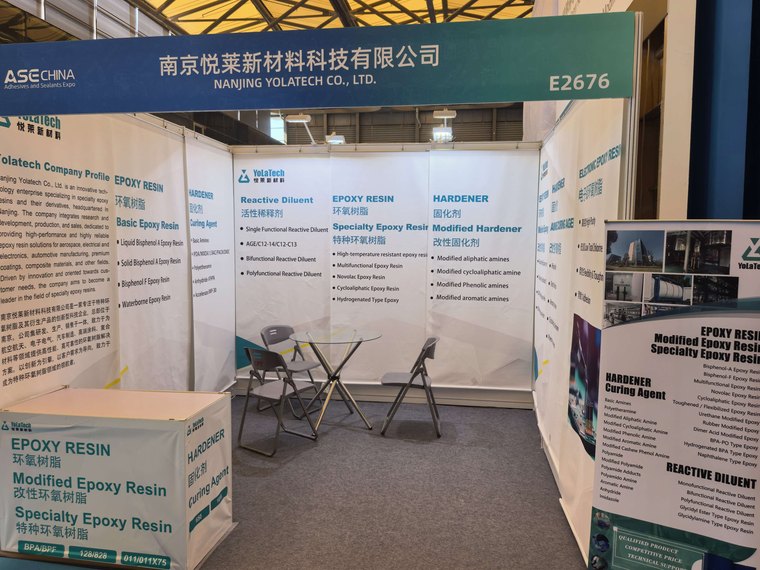
Booth E2676 in Hall E2, with the epoxy resin, hardener and reactive diluent panels.
|
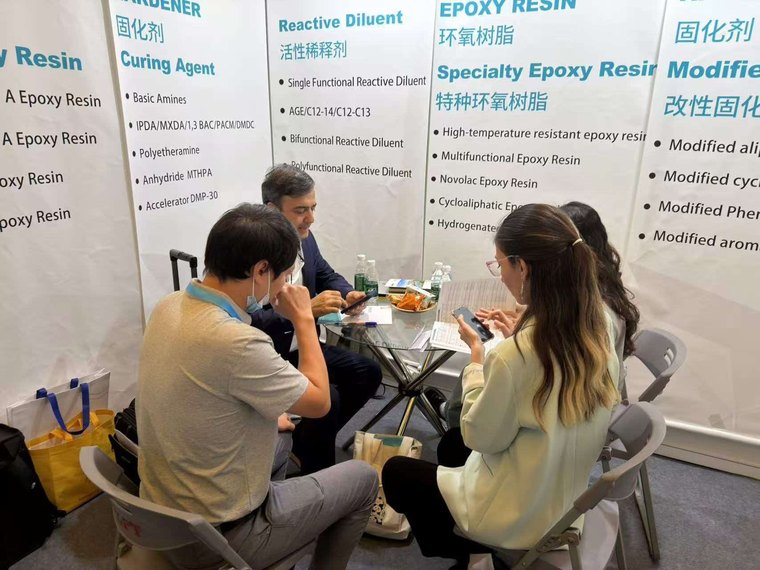
Grade and specification talk at the booth table during the three-day show.
|
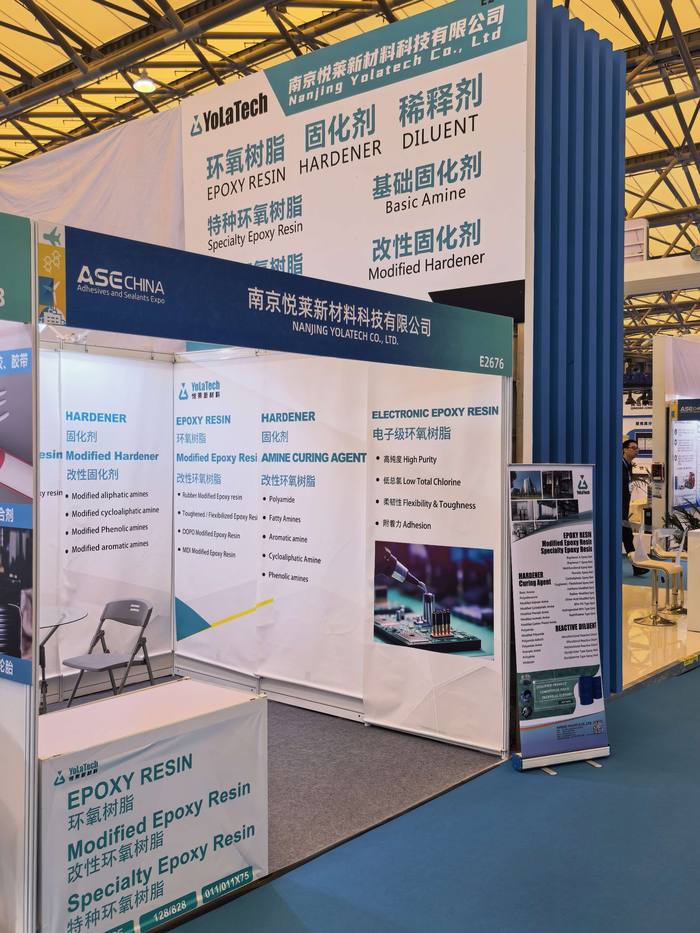
Booth panels listing the modified resin, curing agent and electronic-grade lines.
|
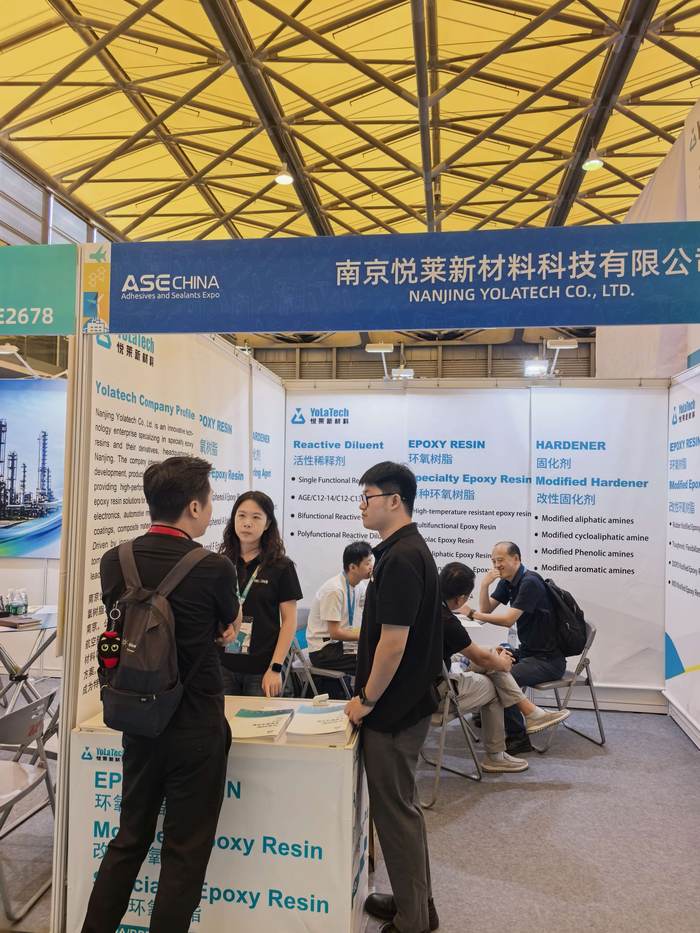
Visitors working through the grade lists with the Yolatech team.
|
Reactive diluents handle viscosity, and they are not a neutral additive. Every 10 phr changes the mixed epoxy equivalent weight, and with it the hardener ratio the formulator has to set. Cardanol-based grades add flexibility and water resistance at the same time, which is why they keep appearing in flooring and marine work.
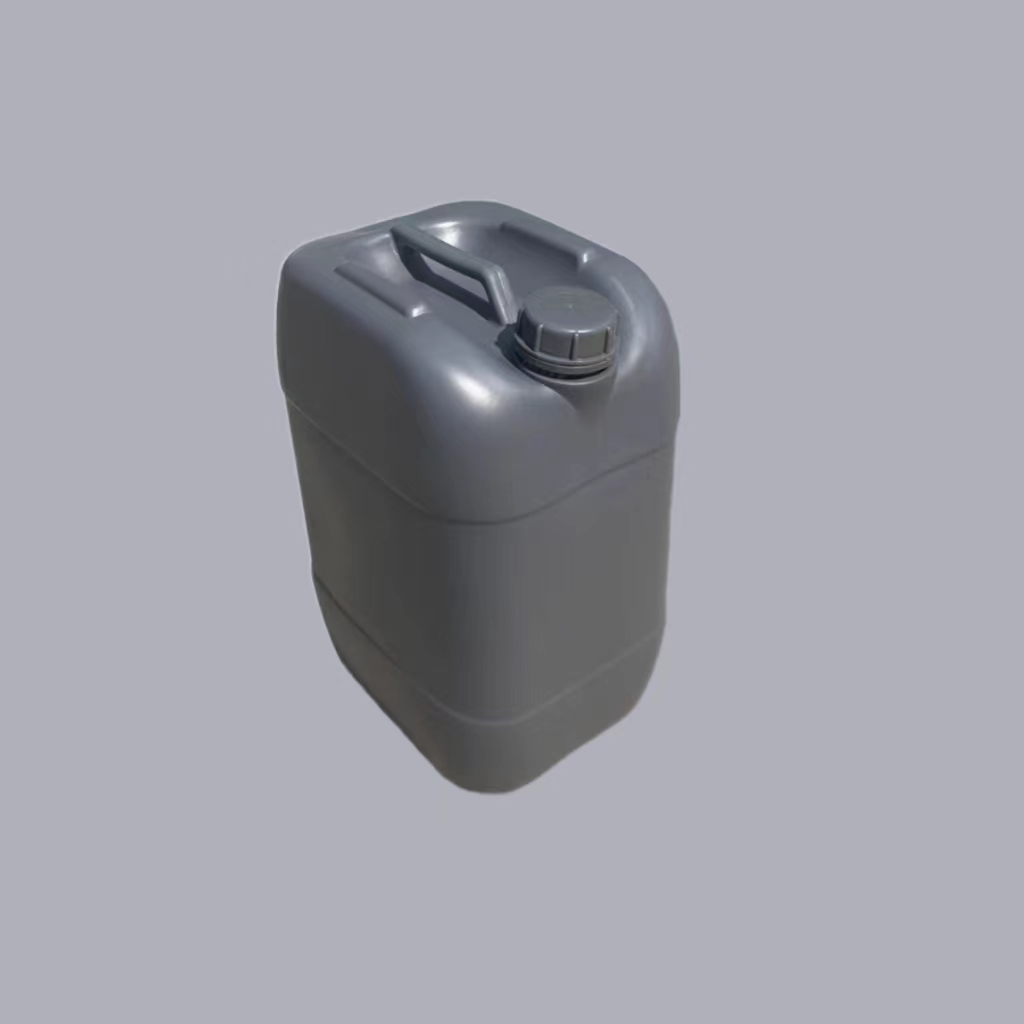
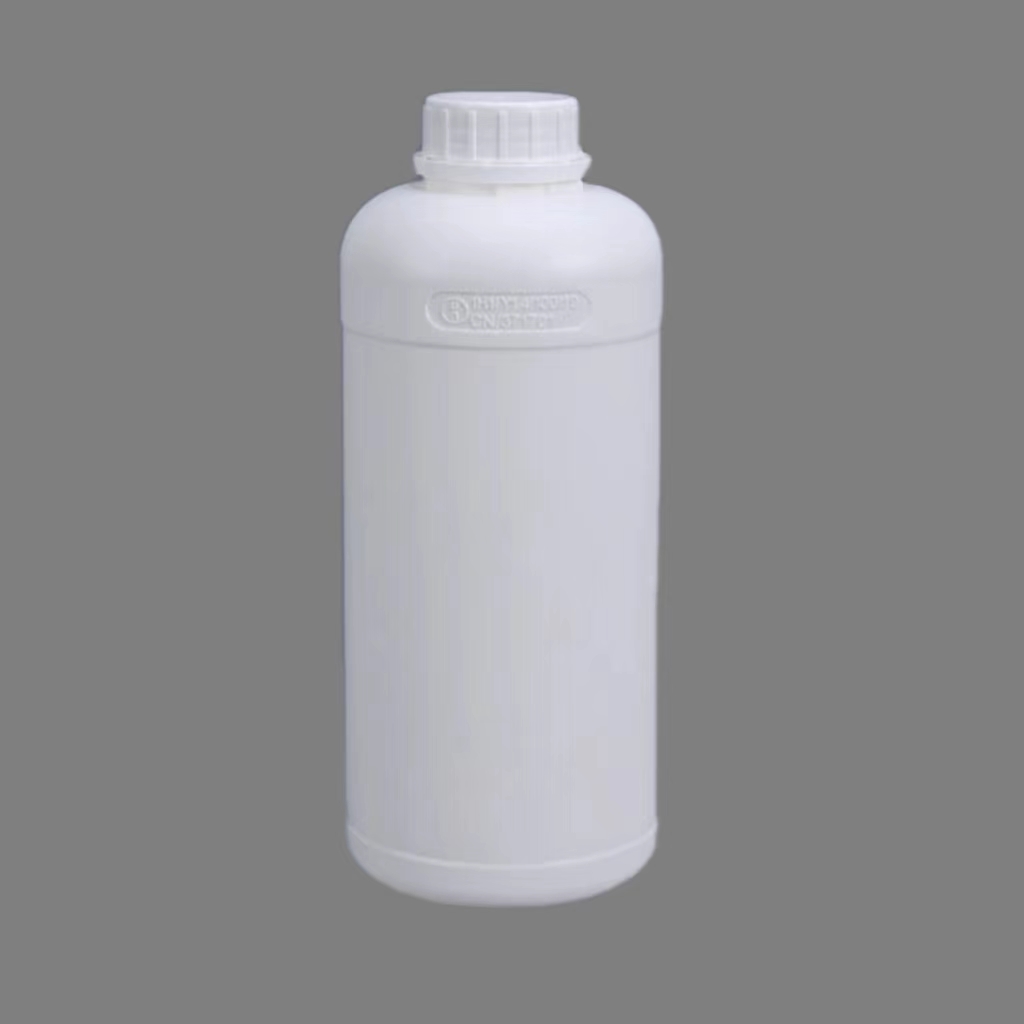
Samples of the resins, hardeners and diluents shown at E2676 are available for laboratory evaluation. Ask for a grade with its TDS, and the COA travels with the lot. Grades that were not on the panels usually come off the same production lines, so a specific EEW or viscosity window is worth asking about directly rather than picking the nearest listed grade. Bisphenol F and bisphenol A base resins are the usual starting point for a first trial.

 شبكة IPv6 المدعومة