Phenolic Novolac Epoxy Resin: YLEP-638 Selection Guide
Oct 13, 2026
Phenolic novolac epoxy resin YLEP-638 is a multifunctional epoxy resin from phenol-formaldehyde novolac and epichlorohydrin. Its published specification lists an epoxy equivalent weight of 170-190 g/eq, Gardner color 3.0 maximum, a softening point of 36-40 °C and hydrolyzable chlorine below 500 ppm.
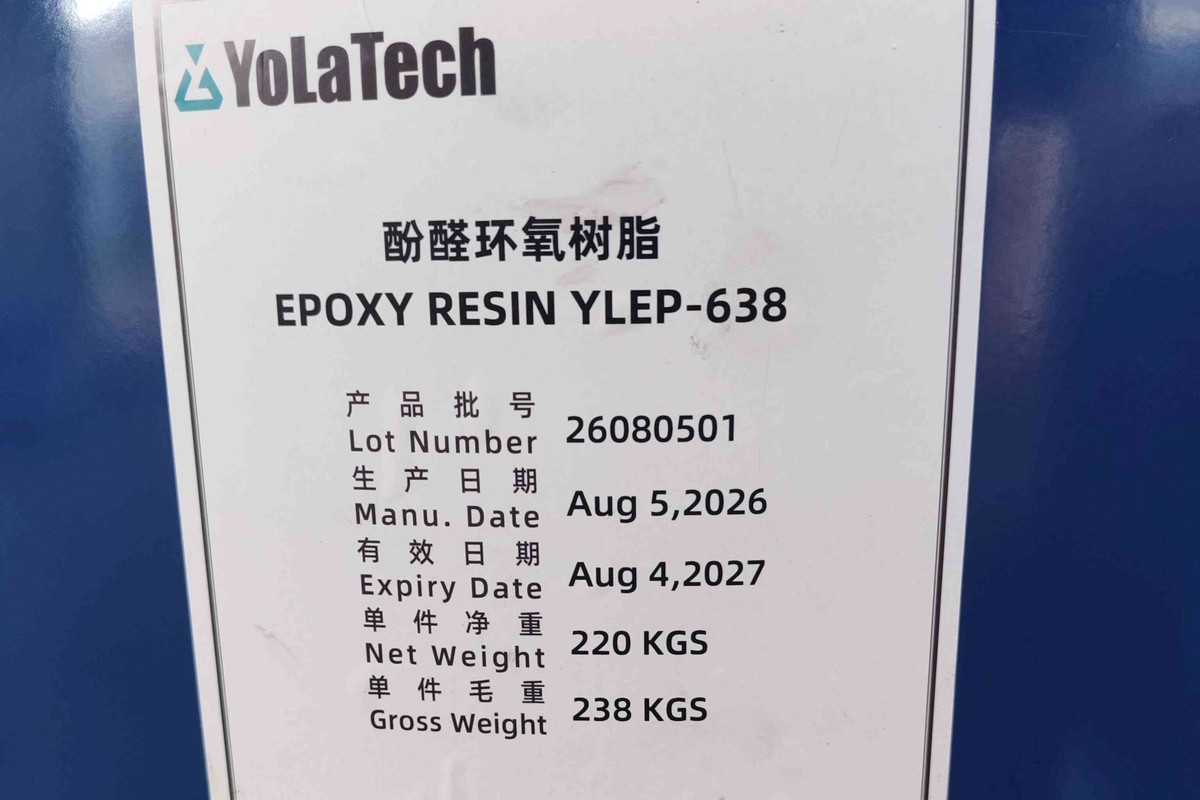
Figure 1. YLEP-638 phenolic novolac epoxy resin is supplied in steel drums and is a semi-solid at room temperature; the printed label carries the lot number, manufacturing date and expiry date.
1. Introduction
Continuous service above roughly 150 °C is where a difunctional bisphenol A epoxy resin stops being the obvious answer. Phenolic novolac epoxy resin trades easy flow for a denser cured network.
Built on a phenol-formaldehyde novolac core condensed with epichlorohydrin, YLEP-638 carries more than two epoxide rings per molecule on average. Published data on the sibling grade YLEP-631 records an average of 2.7 epoxy groups per molecule, against two for bisphenol A diglycidyl ether.
Specification values below are quoted from the public Yolatech product pages, derived constants are marked calculated, and every dosage figure is a worked example rather than a recipe.
Selection comes first. Dosage comes second.
2. Materials and Methods: Identification of Phenolic Novolac Epoxy Resin YLEP-638
The YLEP-638 product page publishes five specification items and a five-line application list. Table 1 sets identity data beside those published values.
2.1 Product Identification and Specification
Table 1 collects identity data from the product page and flags the derived rows.
Table 1. Identity and published specification of phenolic novolac epoxy resin YLEP-638.
Item
Information
Product name
PNE type phenolic epoxy resin YLEP-638
Chemical family
Phenolic novolac (PNE) multifunctional epoxy resin
CAS No.
Not published; confirm on the current TDS / MSDS / COA
Appearance
Colorless to yellowish liquid (as published)
Color, Gardner
3.0 maximum
EEW, g/eq
170-190
Softening point (SP), °C
36-40
Hydrolyzable chlorine, ppm
500 maximum
Epoxy functionality
Above 2 (YLEP-631 published at 2.7)
Packaging
Drum
Shelf life
At least 12 months in original packing
2.2 Test Methods and Data Sources
Values in Table 1 are quoted as published. No independent laboratory work was performed for this report.
Epoxy equivalent weight is determined by titration, and the figure in the current TDS governs. ASTM D1652 and ISO 3001 describe the two common routes.
Color is determined by ASTM D1544. Viscosity of the liquid comparator grades is measured at 25 °C; the YLEP-631 figure is quoted at 52 °C because that grade is not free-flowing at ambient.
Hydrolyzable chlorine is given as one ceiling instead of a range, which matters where ionic chloride drives copper corrosion. Water content is normally found by Karl Fischer titration.
Incoming checks on a novolac epoxy lot are usually run in duplicate, or as n = 3 determinations from separate positions in the same drum.
3. Results and Discussion: Structure, Reactivity and Grade Selection
Two structural facts drive most selection decisions around YLEP-638: the novolac backbone and the 170-190 g/eq epoxy equivalent weight.
3.1 Structure and Reactivity of the Novolac Backbone
Phenol and formaldehyde condense under acid catalysis into a novolac oligomer carrying several phenolic hydroxyls. Epoxidation with epichlorohydrin converts those hydroxyls into glycidyl ether groups, so one molecule can end in more than two epoxide rings.
Higher functionality raises crosslink density after cure. Heat deflection temperature, chemical resistance and hot wet strength climb with it. Elongation falls.
An epoxy equivalent weight of 170-190 g/eq sits close to the 184-190 g/eq of a standard liquid bisphenol A grade, so hardener demand per 100 g of resin stays in the same bracket.
Functionality is the difference maker, not EEW.
3.2 Comparison with Alternative Systems
Table 2 places YLEP-638 beside four published grades that buyers weigh against it.
Table 2. Property comparison of YLEP-638 with alternative epoxy systems (published values).
Property
YLEP-638
YLEP-631
YLE-128 (DGEBA)
YLE-170 (BPF)
YLDP-320
EEW, g/eq
170-190
168-180
184-190
160-180
300-340
Form at ambient
Semi-solid
Liquid
Liquid
Liquid
Solid
Softening point, °C
36-40
Not published
Not published
Not published
70-85
Viscosity
Not published
1100-1700 mPa·s at 52 °C
11000-15000 mPa·s at 25 °C
2000-5000 mPa·s at 25 °C
Not published
Epoxy groups per molecule
Above 2
2.7
2
2
Not published
Bisphenol F resin YLE-170, at 160-180 g/eq and 2000-5000 mPa·s, is the low-viscosity liquid option and wets fibre better than a novolac melt. Its cured heat resistance sits a little lower.
YLEP-631 is the same chemistry at 168-180 g/eq with a published 1100-1700 mPa·s viscosity at 52 °C, so it pours where PNE type phenolic epoxy resin YLEP-638 will not flow unassisted.
YLDP-320 answers a different question: 300-340 g/eq, 3.0% phosphorus, supplied as a solid for halogen-free flame-retardant laminates.
Same backbone, different job.
4. Formulation and Dosage Calculation
For an amine-cured system the stoichiometric hardener loading follows one equation, with phr read as parts per hundred parts of resin by weight.
phr = 100 × AHEW ÷ EEW
Anhydride curing uses the same logic with an anhydride equivalent weight, and the practical ratio usually falls between 0.85 and 1.00 of the theoretical figure.
Table 3. Stoichiometric hardener dosage for phenolic novolac epoxy resin YLEP-638, calculated from the published EEW window.
Hardener
Equivalent weight, g/eq
phr at EEW 170
phr at EEW 180
phr at EEW 190
DETA (CAS 111-40-0), theoretical AHEW
20.6
12.1
11.4
10.8
MACM (CAS 6864-37-5), published AHEW
60
35.3
33.3
31.6
MHHPA (CAS 25550-51-0), anhydride weight at ratio 0.90
151.2
88.9
84.0
79.6
A 500 g batch of YLEP-638 measuring 180 g/eq needs 100 × 60 ÷ 180 = 33.3 phr of MACM curing agent, or about 167 g weighed into the mix.
Treat 33.3 phr as a starting point. Delivered epoxy equivalent weight moves inside the 170-190 g/eq window, and the amine content of a hardener lot rarely lands on the published figure.
5. Processing Notes and Operating Window
YLEP-638 does not pour at room temperature. Warming the drum to 60-80 °C brings it to a workable viscosity, and blending with a liquid grade or a reactive diluent does the same at lower temperature.
Pre-warm resin and hardener separately. Check the MHHPA anhydride or amine against its own viscosity or melting point before either enters the mix.
Mix in one direction and keep the vortex shallow. Air whipped into a high-viscosity novolac blend is hard to remove afterwards.
Degas under vacuum if the part is thick. A 10 to 15 minute step covers sections up to about 25 mm.
Gel time shortens sharply as batch weight grows, because the exotherm of a novolac system concentrates in the mass. Check pot life at your own mix weight instead of trusting a table value.
6. Applications
Five end uses appear on the YLEP-638 product page: coating, potting and casting, adhesive, laminates, and composites.
Table 4. Application fit for phenolic novolac epoxy resin YLEP-638 and the grades commonly blended with it.
Application
Why YLEP-638 fits
Companion grade
Laminates
Dense network, 500 ppm maximum hydrolyzable chlorine
YLDP-320 for flame retardance
Coatings
Chemical and thermal resistance at high service temperature
YLE-170 to cut viscosity
Adhesives
Hot wet strength under sustained load
YLE-128 for flexibility
Composites
Mechanical strength at temperature after post-cure
YLE-170 for fibre wet-out
Potting and casting
Rigid encapsulation of thermally stressed parts
YLE-128 to ease flow
YLEP-638 rarely runs alone. It is blended with a lower-viscosity resin to reach a processable viscosity, and the blend ratio decides the cured balance between heat resistance and toughness.
7. Limitations and Material Verification
7.1 Known Limitations and Unsuitable Cases
Three published details deserve confirmation before YLEP-638 is written into a specification.
The specification table labels its 36-40 °C row as viscosity in degrees Celsius, which describes a softening point rather than a viscosity. Confirm the property on the current TDS.
Appearance is published as a colorless to yellowish liquid, while the product description calls the same resin semi-solid. Both cannot hold for one drum at 25 °C.
No CAS number or epoxy functionality value is published for YLEP-638.
Hand lay-up at ambient is not a suitable process for this grade. Neither is a flexible, impact-critical part: the dense network that buys heat resistance costs elongation.
Pick YLEP-631 when flow governs the process, and YLEP-638 when heat and chemical resistance govern the part.
7.2 Incoming Inspection, Packaging, Storage and Safety
Incoming inspection should confirm epoxy equivalent weight by titration against the lot COA, plus color and hydrolyzable chlorine. Reject a lot whose EEW sits outside 170-190 g/eq, because the dosage table shifts with it.
Storage follows the standard epoxy routine: a well-ventilated area, away from flames and direct sunlight, with the cap closed tightly after each use.
The product page states at least 12 months from manufacture in the original packing at ambient temperature, and drum is the published package.
Safety information sits in the Material Safety Data Sheet. Novolac epoxy resins are skin sensitisers, so gloves and eye protection belong in the handling procedure.
Any RoHS, REACH or UL 94 statement must be verified by the customer against current certificates. No certification is implied by a general product description.
8. Frequently Asked Questions
What is the epoxy equivalent weight of phenolic novolac epoxy resin YLEP-638?
The published range is 170-190 g/eq. Epoxy equivalent weight is determined by titration under the method stated in the current TDS, and ASTM D1652 covers the standard route. Use the lot COA figure for dosage work.
How much hardener does YLEP-638 need per 100 g of resin?
With MACM curing agent at a published AHEW of 60 g/eq, 100 g of YLEP-638 at 180 g/eq takes 33.3 g. The same 100 g with diethylenetriamine DETA at a theoretical 20.6 g/eq takes 11.4 g.
Can YLEP-638 replace a liquid bisphenol A epoxy resin one for one?
Not at ambient temperature. YLE-128 is a 11000-15000 mPa·s liquid, while YLEP-638 is a semi-solid with a 36-40 °C softening point, so warming or blending is required. Expect shorter gel time and a stiffer cured part.
Why is YLEP-638 supplied as a semi-solid rather than a liquid?
The novolac backbone raises functionality, and higher functionality raises viscosity at a given epoxy equivalent weight. That is the trade-off the grade accepts in return for a denser cured network.
What is the difference between YLEP-638 and YLEP-631?
Both are PNE-type phenolic novolac epoxy resins capped at 500 ppm hydrolyzable chlorine. YLEP-631 is published at 168-180 g/eq with a 1100-1700 mPa·s viscosity at 52 °C; YLEP-638 is published at 170-190 g/eq with a 36-40 °C softening point.
Is YLEP-638 suitable for halogen-free electronic laminates?
It can serve as the base resin, but it carries neither phosphorus nor bromine, so flame retardance has to come from the hardener, from a co-resin such as YLDP-320 at 3.0% phosphorus, or from an additive. Hydrolyzable chlorine at 500 ppm maximum is the ionic figure that matters.
9. Conclusions
YLEP-638 is a PNE-type phenolic novolac epoxy resin published at 170-190 g/eq, 3.0 maximum Gardner color, a 36-40 °C softening point and 500 ppm maximum hydrolyzable chlorine. It ships in drums with a stated 12-month shelf life.
Its value lies in crosslink density rather than in flow. Warm it or blend it, then dose by stoichiometry from the measured epoxy equivalent weight of the lot.
Choose the lower-viscosity YLEP-631 phenolic novolac grade when flow governs the process, and YLEP-638 when heat and chemical resistance govern the part.
10. References
1. Product page, PNE type phenolic epoxy resin YLEP-638, Yolatech: https://www.yolatech.com/pne-type-phenolic-epoxy-resin-ylep-638
2. Product page, PNE type phenolic epoxy resin YLEP-631, Yolatech: https://www.yolatech.com/pne-type-phenolic-epoxy-resin-ylep-631
3. Product page, bisphenol A epoxy resin grades YLE-127 and YLE-128, Yolatech: https://www.yolatech.com/bisphenol-a-epoxy-resin
4. Product page, bisphenol F epoxy resin grade YLE-170, Yolatech: https://www.yolatech.com/bisphenol-f-epoxy-resin
5. Product page, DOPO-HQ modified phenolic epoxy resin YLDP-320, Yolatech: https://www.yolatech.com/dopo-hq-modified-phenolic-epoxy-resin-yldp-320
6. Technical Data Sheet, Material Safety Data Sheet and Certificate of Analysis for PNE type phenolic epoxy resin YLEP-638, Yolatech (available on request).
7. ASTM D1652, epoxy content of epoxy resins (EEW); ISO 3001, determination of epoxy equivalent.
8. ASTM D1544, Gardner color of transparent liquids; ASTM D445, kinematic viscosity; ASTM E203, water content by Karl Fischer titration.
إقرأ المزيد






 شبكة IPv6 المدعومة