

اللغة
:

اللغة
:

CHINACOAT 2026 is the 30th edition of China's international coatings exhibition, held 11 to 13 November 2026 in Guangzhou. Yolatech showed liquid and solid epoxy resins, curing agents and reactive diluents at our joint stand in Area A of the Canton Fair Complex, thirty years after the first edition.
CHINACOAT has run since 1996 and alternates each year between Guangzhou and Shanghai. The 2026 edition was the 30th, a milestone the organiser marked with a retrospective and a visitor draw. The floor stayed upstream: raw materials and resins on one side, production and testing equipment on the other, so a coatings formulator could compare a base resin, the hardener that crosslinks it and the dispersing equipment in one afternoon.
The scale is what makes the show useful for export work. As of August 2026 the organiser had confirmed more than 1,250 exhibitors from 28 countries across 9.5 halls and over 99,000 sq m, updated to 1,280 in September. The 2025 Shanghai edition drew 45,024 visitors from 125 countries.
| Table 1. CHINACOAT 2026 | Detail |
| Edition | 30th, thirty years after the 1996 first edition |
| Dates | 11 to 13 November 2026 |
| Venue | Area A, China Import and Export Fair Complex, 380 Yuejiang Zhong Road, Haizhu District, Guangzhou |
| Organiser | Sinostar-ITE International and CHINACOAT Exhibition, with New Expostar (Shenzhen) |
| Reported scale | 1,250+ exhibitors from 28 countries and regions as of August 2026, updated to 1,280+ in September |
| Exhibition space | Over 99,000 sq m across 9.5 halls |
| Previous edition | Shanghai 2025: 45,024 visitors from 125 countries, 1,464 exhibitors from 30 countries |
| Concurrent programme | National coatings presentations for Indonesia and Turkiye, technical seminars, exhibitor technical sessions |
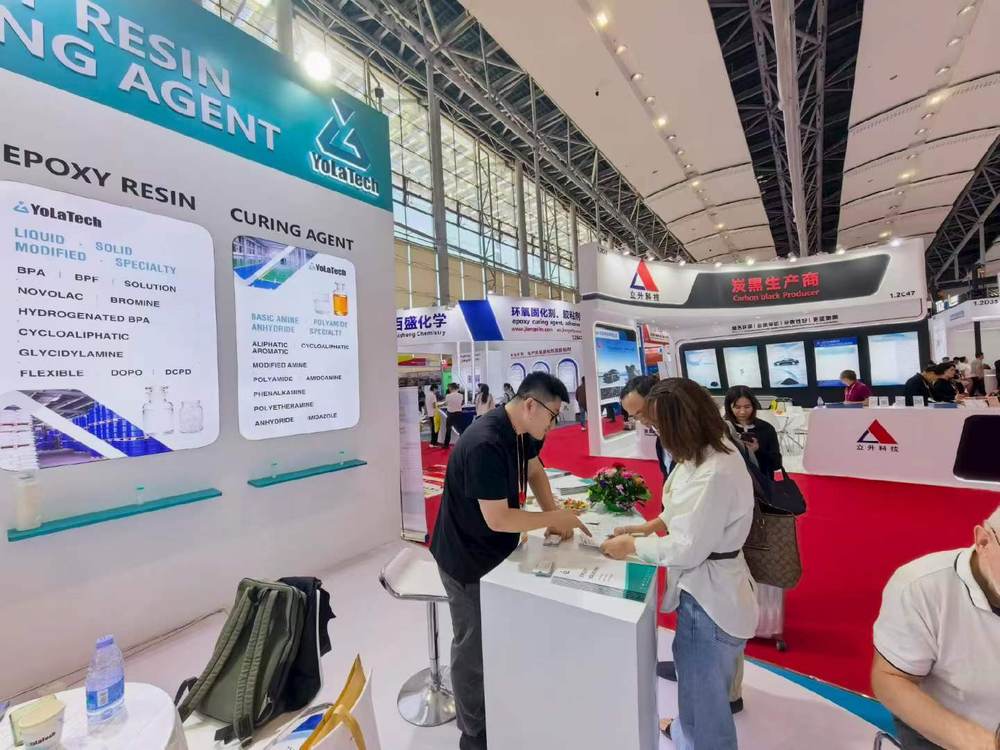
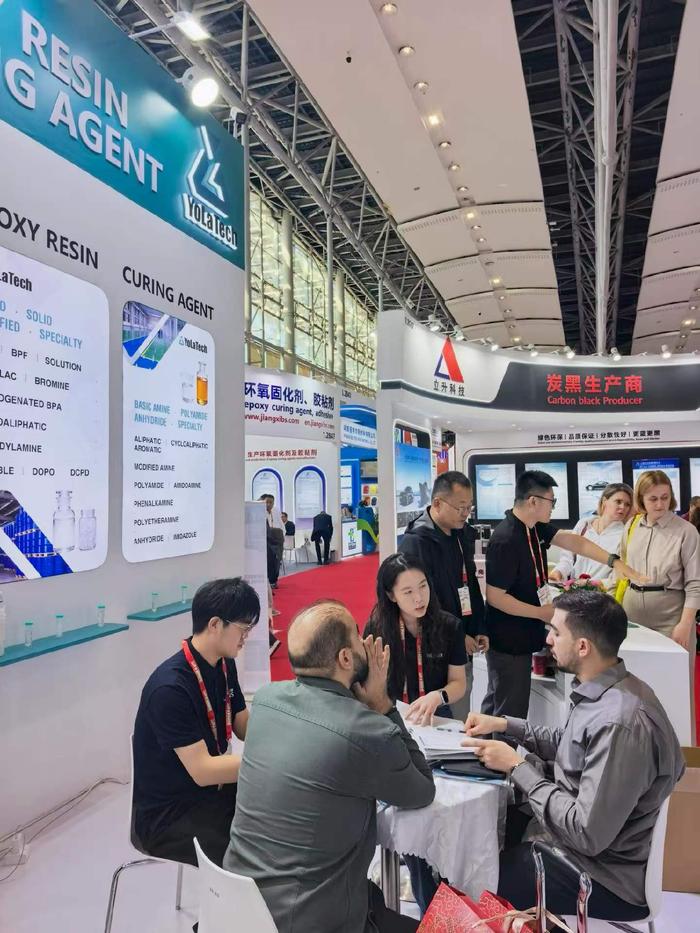
The stand was shared with the group's cellulose and nitrocellulose brands, so the aisle showed a supporting-products wall next to the epoxy wall. For a coatings buyer that is useful: a formulation needing a rheology modifier and an epoxy hardener could be discussed at one table instead of two booths.
The epoxy panel was divided into four columns, matching how the range is sold. Liquid covered bisphenol A, bisphenol F, novolac and brominated types. Modified covered urethane, rubber, dimer acid and DOPO flame-retardant grades. Solid covered flake bisphenol A. Specialty covered hydrogenated bisphenol A, cycloaliphatic, glycidylamine and DCPD types. The hardener panel ran the same way, from basic aliphatic, aromatic and cycloaliphatic amines through modified amines, polyamide and phenalkamine to polyetheramine, anhydride and imidazole.
| Panel group | Grade | Key data | Product page |
| Liquid epoxy resin, bisphenol A | YLE-127, YLE-128 | EEW 176 to 190 g/eq | Liquid bisphenol A epoxy resin |
| Liquid epoxy resin, bisphenol F | YLE-170 | Lower viscosity than the bisphenol A grades | Bisphenol F epoxy resin |
| Solid epoxy resin, flake | YLE-011, YLE-901 | EEW 450 to 500 g/eq | Solid bisphenol A epoxy resin |
| Solvent-cut epoxy resin | YLE-127A95, YLE-901K70 | Non-volatile 70 to 96 % | Solvent type bisphenol A epoxy resin |
| Specialty epoxy resin, novolac | YLEP-170, YLEP-172 | EEW 165 to 178 g/eq | Phenolic epoxy resin |
| Specialty epoxy resin, cycloaliphatic | YLSE series | Low viscosity, UV-stable backbone | Cycloaliphatic epoxy resin |
| Curing agent, polyetheramine | D-230 | Amine value min. 7.5 mmol/g | Polyetheramine D-230 |
| Reactive diluent, AGE | YLD-7003 | CAS 68609-97-2, EEW 294 to 313 g/eq | Alkyl C12-C14 glycidyl ether YLD-7003 |
 |
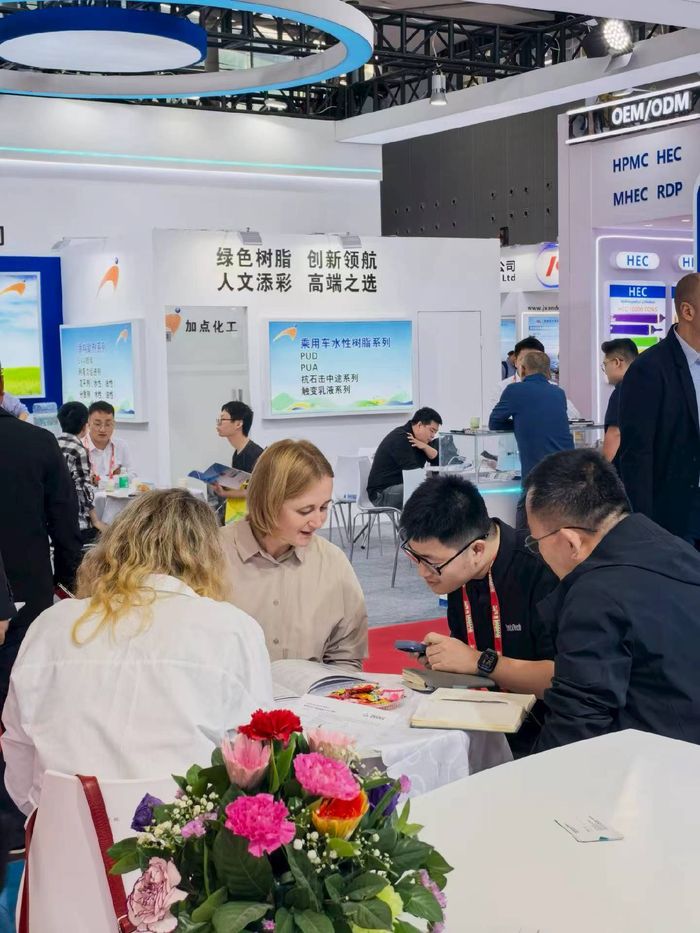
Three questions came up repeatedly over the three days, and all three are cost questions before they are chemistry questions. Lower volatile content without losing film build, viscosity low enough to spray or roll at high solids, and corrosion protection that still passes salt spray after the solvent is reduced.
Viscosity drew the most traffic. Waterborne and high-solids systems both push the formulator toward a reactive diluent, because a conventional solvent drop raises VOC and a plasticiser drop softens the film. AGE (C12-C14) at 4 to 10 mPa·s was the grade most often written down, usually against a liquid bisphenol A or novolac base for a tank, pipe or floor coating. Our page on epoxy resin coatings sets out how resin, hardener and diluent are matched for these systems.
Hardener ratio came second. Visitors arrived with a base resin already on the bench and wanted the amine value and mixing ratio for it, which is a data question rather than a sales question. Polyetheramine D-230 and modified amine hardeners came up in the same conversations, generally where a room-temperature cure was too slow for a maintenance schedule or a winter application window.
 |
 |
Samples of the grades shown at CHINACOAT 2026 are available for laboratory evaluation. Each grade ships with its TDS, and the COA travels with the lot, so a formulator can check EEW, viscosity or amine value against the certificate before scale-up. Where a visitor's target sits between two production grades, the usual route is a trial lot rather than an off-spec blend.
The working order is the one the panels followed: resin family first, then hardener, then diluent. Liquid bisphenol A epoxy resin and solid bisphenol A epoxy resin are the usual starting points, with solvent-cut grades where a working viscosity is needed straight from the drum. Phenolic epoxy resin and cycloaliphatic epoxy resin cover the heat-resistant and UV-stable ends of the range.
Send a target EEW, viscosity or amine value and it will be matched against the nearest production grade rather than the nearest listed one.

 شبكة IPv6 المدعومة