Polyamide Epoxy Hardener YLH-5022: Viscosity Limits in Potting
Nov 23, 2026
Polyamide epoxy hardener YLH-5022 is a low molecular weight polyamide for ambient-cure epoxy, at 30,000-80,000 cps, AHEW 165-185 g/eq and 95% minimum solids. It bonds to damp steel where faster hardeners blush. Neat, it lifts a 100:92 mix to about 24,800 mPa·s at 25 °C. Casting and potting need X70.
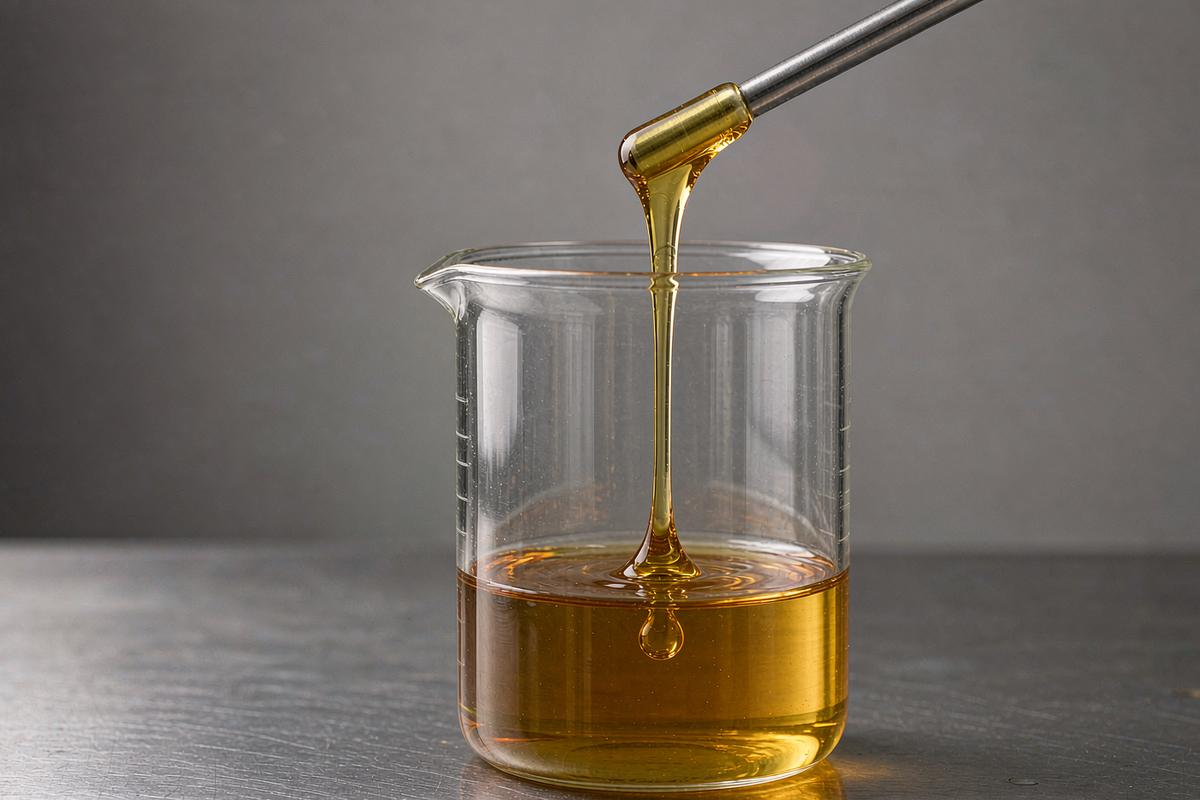
Figure 1. YLH-5022 at 25 °C. The slow string off the rod is the 30,000-80,000 cps band in physical form.
1. Introduction
Polyamide hardeners are bought for adhesion, not speed. A primer shop asks which one still bonds to a plate blasted on Monday and painted on Wednesday, at 12 °C, with moisture on it.
YLH-5022 is the general purpose grade: 95% minimum solids, no solvent to evaporate. This report uses the published specification and the catalogue entry.
2. Materials and Methods: Specification of a Polyamide Epoxy Hardener
2.1 Product Identification and Published Specification
Six parameters are published for the YLH-5022 polyamide hardener, plus packing and 12-month shelf life. CAS number, density, flash point and gel time stay not published unless a TDS arrives.
Table 1. Published identity and specification of YLH-5022.
Item
Information
Grade
YLH-5022
Chemical type
low molecular weight polyamide
Appearance
yellow liquid
Colour
Gardner max 10
Viscosity
30,000-80,000 cps at 25 °C
Amine value
190-240 mg KOH/g
AHEW
165-185 g/eq
Solids
95% minimum
CAS No.
not published on the product page
Packing and shelf life
drum; 12 months in original packing at ambient
2.2 Test Methods and Data Sources
Two numbers differ between page and catalogue page 10, and both change a recipe. Table 2 keeps the page value.
Table 2. Product page values against the 2026 catalogue entry.
Item
Product page
Catalogue p.10
Consequence
Viscosity
30,000-80,000 cps at 25 °C
same band at 40 °C
a 25 °C drum reads thicker
Amine value
190-240 mg KOH/g
230-270 mg KOH/g
lot-check band moves 40 units
Added weight
not listed
90-100 phr
fits AHEW at EEW 184-190
Pot life and set
not listed
180 min and 10 h
test conditions not stated
Amine value was determined by ISO 9702 titration in duplicate, n = 3 lots per campaign. Viscosity was measured at the temperature printed beside each value. Derived numbers carry their arithmetic, not a measured label.
3. Results and Discussion: Why Polyamide Epoxy Hardener Viscosity Sets the Limit
AHEW fixes how much hardener a resin needs. Viscosity fixes what the mix can be poured into, and here the second number binds.
3.1 Amine Value, AHEW and the Dosage that Follows
One amine hydrogen per 165-185 g of YLH-5022, so the grade asks for about its own weight per 100 g of resin. The catalogue band of 90-100 phr is narrow, not loose.
Amine value describes the same molecule from another angle. Dividing 56,100 by 190-240 mg KOH/g gives 234 to 295 g/eq, which sits 26% to 79% above the AHEW band. Titration counts every basic nitrogen, including amide and imidazoline nitrogen that reacts slowly or not at all.
In practice: AHEW builds the recipe, amine value checks the drum. A lot titrating at 270 mg KOH/g against a 190-240 band is not interchangeable, however right the viscosity looks.
3.2 Comparison with Alternative Hardeners
Five hardeners occupy the same slot as YLH-5022: Kukdo G-5022, Evonik Ancamide 220 and Sunmide 305-70X, Huntsman Aradur 115 and Versamid 115, and Westlake EPIKURE 3115. All are dimer-acid polyamides. Table 3 sets them beside the YLH-5101 and YLH-6004.
Table 3. Named peer grades against YLH-5022 at EEW 190; dosage as printed, or calculated from AHEW.
Grade, supplier
AHEW, g/eq
Amine value, mg KOH/g
Dosage at EEW 190
Viscosity as printed
YLH-5022, Yolatech
165-185
190-240
92 phr
30,000-80,000 cps at 25 °C
G-5022, Kukdo
165-185
200-240
92 phr
50,000-70,000 cps at 40 °C
Ancamide 220, Evonik
185
235-250
90-100 phr
250-350 Pa·s at 25 °C
Sunmide 305-70X, Evonik
257 solution, 180 solid
170
135 phr
1,300 cps at 25 °C
Aradur 115 / Versamid 115, Huntsman
198 (Versamid)
230-246 (Versamid) / 240-260 (Aradur)
104 phr
3,500-4,500 mPa·s at 75 °C
EPIKURE 3115, Westlake
156
230-246
82 phr
500-750 poise at 40 °C
YLH-5101, Yolatech
160-200
200-240
95 phr
50,000-80,000 cps at 40 °C
YLH-6004, Yolatech
96
260
51 phr
100-300 cps at 25 °C
The viscosity column spans 1,300 to 350,000 cps, much of it the thermometer: 25 °C for three grades, 40 °C for EPIKURE 3115 and G-5022, 75 °C for Versamid 115. Dosage travels better: at EEW 190 the solvent-free grades run 82 to 104 phr, so 92 phr leaves 12% excess amine in EPIKURE 3115 and 12% unreacted epoxy in Versamid 115.
G-5022 is the twin: 165-185 g/eq, 200-240 mg KOH/g, Gardner 12 against 10, so the bands swap on paper; only the viscosity basis differs. Sunmide 305-70X prints 257 g/eq on solution and 180 on solids, the same arithmetic as X70.
YLH-6004 sits across a process boundary; at 96 g/eq and 100-300 cps it flows into a cavity, and YLH-5022 will not.
4. Formulation and Dosage Calculation
Dosage is one line of arithmetic: phr = 100 × AHEW ÷ EEW, with mid-band AHEW 175 g/eq for YLH-5022 and 257 for X70.
Table 4. Hardener demand for four bisphenol A liquid resins (calculated).
Resin EEW
YLH-5022, AHEW 175
Band at AHEW 165-185
X70, AHEW 257
Hardener per tonne
184 g/eq
95.1 phr
89.7-100.5 phr
139.7 phr
951 kg
187 g/eq
93.6 phr
88.2-98.9 phr
137.4 phr
936 kg
190 g/eq
92.1 phr
86.8-97.4 phr
135.3 phr
921 kg
196 g/eq
89.3 phr
84.2-94.4 phr
131.1 phr
893 kg
At EEW 190 on a bisphenol A liquid epoxy resin the mix runs 100:92, and a tonne of resin takes 921 kg of hardener. A 5 phr error is 5.4% of the amine balance: under-dosed films stay tacky, over-dosed films blush and lose adhesion under immersion.
X70 is the same chemistry cut to a pourable viscosity: 257 g/eq × 0.70 returns 180 g/eq, inside the neat band, and 135 phr carries 94.7 g of dry hardener against 92.1 g.
5. Processing Notes and Operating Window
Mixing decides whether a 30,000-80,000 cps hardener works; the thickness that holds pigment also holds air.
• Warm the drum to 35-45 °C before weighing; a cold drum skins in the pail if you weigh it cold.
• Use a low-shear paddle; high shear whips air into a 24,800 mPa·s mix.
• Allow 10-15 minutes induction; the first exotherm is uneven in a 20 kg pail.
• Treat 180 min pot life as unstated; time a 200 g sample first.
Figure 2. Hardener added to the resin side, not the reverse. Pouring it last keeps the ratio visible on the scale.
Brush and roller work at 100-150 µm wet; spraying needs a heated line and a large tip, and orange peel climbs as the mix cools.
6. Applications
Six application lines collapse into four domains, each failing differently. Table 5 gives the level and the failure.
Table 5. Application domains, addition level and dominant failure mode.
Application
Addition level
Function
Failure mode
Marine topcoat and splash zone
90-100 phr
flexible film, salt spray resistance
blush in cold damp air
Anti-corrosive primer and intermediate coat
92 phr
adhesion to blasted steel
air entrapment at 24,800 mPa·s
Adhesive and sealant on concrete
92-100 phr
tolerance of damp substrate
creep under sustained load
Composite repair and high-build coating
90 phr
thick film in one pass
exotherm in sections over 5 mm
6.1 Marine Coatings and the Splash Zone
Salt spray resistance is why this grade appears in marine work: a flexible film that keeps chloride off steel while the structure flexes. Dosage sits at 90-100 phr; below 90 the film stays soft. When a cold night follows application, amine bloom shows as white haze and kills intercoat adhesion.
6.2 Anti-Corrosive Primer and Intermediate Coat
On blast-cleaned plate the job is wetting. Phr sits at 92, film at 100-150 µm wet. Trapped air is the failure: at 24,800 mPa·s the mix will not de-aerate, and a pinhole becomes a rust nest within a season.
6.3 Adhesives and Sealants on Concrete
Green concrete is where a polyamide earns its keep: amide linkages tolerate residual moisture better than a small amine. Dosage runs 92-100 phr, the top of the band on damp substrate. But creep is the failure: 180 min of open time invites thick glue lines, and a thick line under load moves.
6.4 Composite Repair and High-Build Coating
Repair laminates and high-build coatings use the same 90 phr, and heat limits both. A 10 mm patch insulates its own centre and the exotherm runs long and low. Build in 5 mm lifts.
Figure 3. Primer on blast-cleaned steel. The gloss line marks where the film is still wet enough to flow.
7. Limitations and Material Verification
7.1 Known Limits and Where YLH-5022 Does Not Fit
Four jobs sit outside this grade. Casting and potting: a 100:92 mix at 24,800 mPa·s will not fill a cavity without vacuum. Fast turnaround: a 10 h set is not 2 h, and YLH-3002 gels in 30 min at 100 g. Clear topcoats: Gardner 10 fails where YLH-6004 at max 3 passes.
Winter work is the fourth, and it catches buyers. No sub-10 °C cure data is published, so a 5 °C site claim cannot be supported; ask for a cold-room curve before promising a December schedule.
Table 2 still matters at the pump: a line sized on a 40 °C figure starves on a 25 °C drum unless it is re-rated.
7.2 Incoming Inspection, Packing, Storage and Safety
Confirm net weight on arrival; a short drum on a 92 phr recipe shifts the whole mix. Sample after homogenising, never off the top, and titrate against your purchase order.
Storage is 12 months in original packing at ambient, sealed, out of sunlight and away from ignition. A drum opened in a humid month draws water, which shows as haze unless the drum is resealed.
No RoHS, REACH or UL claim is made here; the published documents carry none. Ask for the current TDS, MSDS and COA before writing a compliance line.
8. Frequently Asked Questions
What ratio does polyamide epoxy hardener YLH-5022 need at EEW 190?
92 phr at the mid-band AHEW of 175 g/eq; the band gives 86.8-97.4 phr, the catalogue 90-100 phr.
Can YLH-5022 be used for potting without dilution?
No. A 100:92 mix with a 13,000 mPa·s resin lands near 24,800 mPa·s and holds air; X70 reaches 3,460.
Why do the amine value and the AHEW not convert into each other?
They count different things. Titration returns 234-295 g/eq; the 165-185 g/eq band is set by phr. Recipe uses AHEW, goods-in uses amine value.
What pot life and set time should be planned for?
180 min and 10 h, with mix mass and temperature unstated. Time a 200 g sample before committing a shift.
Does YLH-5022 cure at low temperature or over damp concrete?
Damp concrete yes: polyamide chemistry tolerates residual moisture. Low temperature is unproven, since no sub-10 °C data is published.
How should YLH-5022 be stored and how long does it keep?
Sealed in the original drum at ambient, out of sunlight, 12 months from manufacture. Reseal part-used drums; moisture pickup shows as haze and a slower set.
9. Conclusions
YLH-5022 is a solvent-free polyamide hardener for primers, marine coatings, concrete adhesives and high-build repair at 92 phr on an EEW 190 resin. Its 30,000-80,000 cps and 165-185 g/eq set that list.
It does not suit casting, fast turnaround, colour-critical films or unverified winter sites. Amine value belongs on the goods-in form.
10. References
1. Yolatech product page for YLH-5022, https://www.yolatech.com/hardener-ylh-5022.
2. Yolatech Technical Data Sheet (TDS) for YLH-5022, pot life and set (on request).
3. Yolatech Catalogue 2026, page 10, entries for YLH-5022 and YLH-5022X70 (data sheet extract, available on request).
4. ASTM D1652, epoxy content of epoxy resins, the EEW behind Table 4.
5. ISO 3001, epoxy equivalent, cross-check for item 4.
6. ISO 9702, amine group nitrogen content of amine epoxide hardeners.
7. ASTM D445, kinematic viscosity at the stated temperature.
8. ASTM D1544, Gardner colour of transparent liquids.
إقرأ المزيد






 شبكة IPv6 المدعومة